The cube and the notation
The three kinds of piece
A 3×3 does not have 26 interchangeable pieces. It has three families, and a piece never changes family. This is the most important idea on the whole page.
| Count | Stickers | What makes them special | |
|---|---|---|---|
| Centres | 6 | 1 | They never move relative to each other |
| Edges | 12 | 2 | Between two centres |
| Corners | 8 | 3 | At the eight vertices |
The centres define the colours
Turning a face does not move its centre. So the green centre is the green face, by definition — even on a completely scrambled cube. When you are looking for where a piece goes, look at the centres, never at the other pieces.
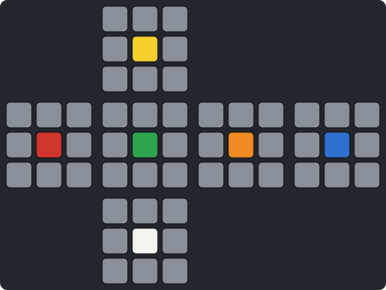
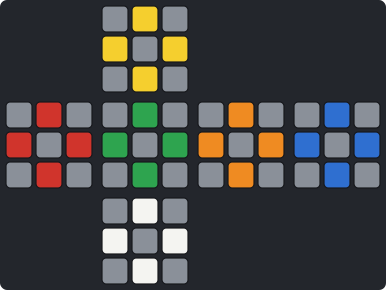
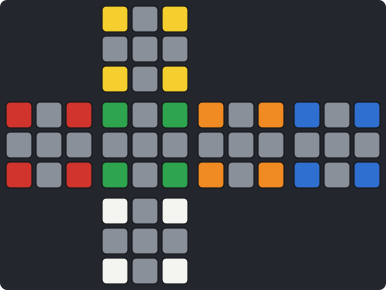
A piece never changes family: these three sets never mix.
It is also why a blue-orange edge can never go between the green centre and
the red centre: it does not have the right colours.
Holding the cube
One rule, valid across the whole site: the face that matters is on top, and you do not turn the cube over in the middle of an algorithm.
The cube has three reading axes:
- U (Up) on top, D (Down) underneath
- F (Front) facing you, B (Back) behind
- R (Right) on the right, L (Left) on the left
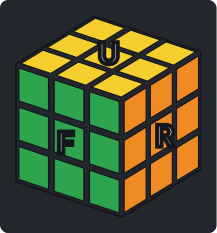
These letters name a position, not a colour. R means "the face that is on
your right right now", whatever colour it happens to be.
The notation
The six basic moves
A letter on its own = a quarter turn of that face, clockwise, looking straight at that face.
| Notation | Read as | Effect |
|---|---|---|
R |
R | The right face, a quarter turn clockwise |
R' |
R prime | The right face, a quarter turn anticlockwise |
R2 |
R two | The right face, a half turn (direction does not matter) |
And the same for U, D, F, B, L.
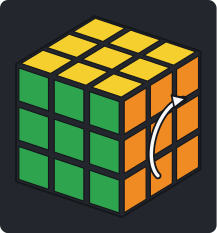
the front of R goes up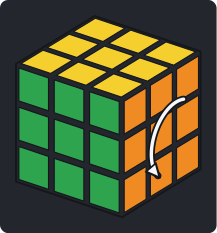
the reverse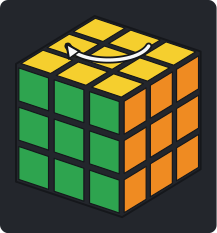
the top face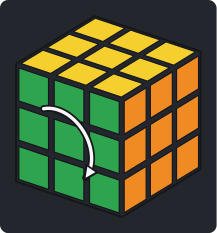
the front faceThe clockwise trap
"Clockwise" is understood looking at the face in question. For D (the
bottom face) you therefore have to imagine yourself under the cube looking
up at it. Seen from above, a D looks anticlockwise. This is the number one
beginner mistake — and the reason good algorithms avoid D.
The slice moves
The slice is the middle layer, the one that contains no corner.
| Notation | Read as | Effect |
|---|---|---|
M |
M | Slice between L and R, it follows the direction of L |
E |
E | Slice between U and D, it follows the direction of D |
S |
S | Slice between F and B, it follows the direction of F |
M is by far the most used (it appears in the best edge algorithms). Just
remember: M goes the same way as L, that is, towards you over the top.
Whole-cube rotations
| Notation | Effect |
|---|---|
x |
The whole cube tips in the direction of R (the front goes up) |
y |
The whole cube turns in the direction of U |
z |
The whole cube pivots in the direction of F |
A rotation solves nothing: it only changes which face is in front of you. You need none of them for the beginner method.
Wide moves
A lowercase letter = the face and the slice behind it, two layers at
once. r = R + M'. You only need them from full OLL onwards.
Practising your reading
Take your solved cube and slowly execute:
R U R' U'
Do it six times in a row. The cube comes back exactly to the solved state. If it does not, you reversed a direction somewhere — start again from a solved cube, more slowly.
Why it works
This sequence is called the sexy move, and it is the most used sequence on the whole cube. It has the property of being of order 6: repeated six times, it returns to its starting point. That makes it an excellent test that you are reading the notation correctly.
Once R U R' U' × 6 brings you back to a solved cube first try, you can read the
notation. You are ready for the beginner method.