1 · The white cross
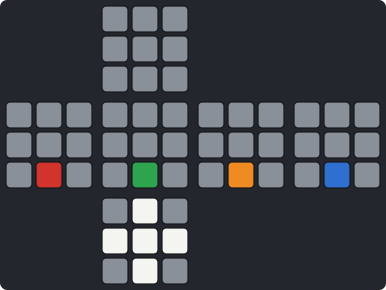
Look carefully at the diagram: on the side faces there is a coloured sticker under each arm, and it is the same colour as the centre of its face. That is what counts. A white cross whose sides are not matched is useless.
The daisy method
This is the simplest route, and it avoids turning the cube over entirely.
Stage A — build the daisy
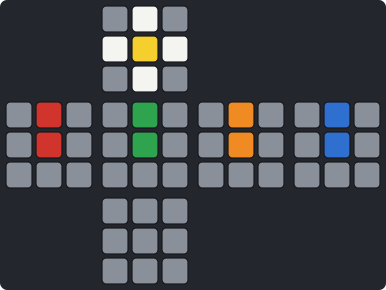
Hold the cube yellow on top. Bring the four edges that contain white around the yellow centre, white facing up. You get a flower: a yellow heart, four white petals.
There is no algorithm here: you find a white edge and you bring it up.
- White edge in the bottom layer? Turn that face twice (
F2for example) to send it straight up. - White edge in the middle layer? A quarter turn of the right or left face
brings it up. If that would knock out a petal already in place, turn
Ufirst to move the petal out of harm's way. - White edge already on top but white facing sideways? Leave it, stage B fixes it.
The reflex that unblocks everything
If a move breaks a petal you already placed, it does not matter: turn U a
quarter, make your move, put U back. This idea — move it out of the way,
act, put it back — is the foundation of the entire cube.
Stage B — bring each petal down

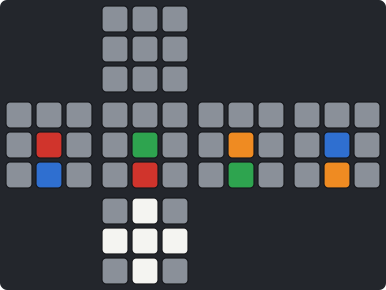
Take a petal. Look at its second colour, the one on the side.
- Turn
Uuntil that colour is directly above the centre of the same colour. The red petal must end up on the face whose centre is red. - Turn that face a half turn. The edge comes down into place.
Repeat for all four petals. Careful: never bring a petal down without first lining up its colour — that is the only mistake possible at this step.
Check
Turn the cube over to look at the white face: you should see a white cross. Then look at the four side faces: under each arm, a sticker matching its centre. If so, the step is done.
How long it takes
This step is the only completely free one. At first, take your time. Later it takes eight moves and a few seconds — see The efficient cross.