Start here
This site teaches you to solve a 3×3 Rubik's Cube, starting from nothing and going all the way to competition methods. It is one single progression: you never learn the same thing twice, and every step reuses the previous one.
Pick your starting point
-
I have never solved a cube
Go straight to the beginner method. Seven steps, six algorithms to remember in total. Expect two hours for your first solved cube, and a few days before you can do it without looking.
-
I can solve it, I want to go faster
Read Moving on to CFOP. You keep your current method during the transition. The first real gain is not learning algorithms, it is F2L.
-
I already do CFOP
The reference pages: 57 OLL, 21 PLL, 41 F2L cases. All of it readable on a phone, cube in hand.
How to read the diagrams
Two views come back everywhere on this site.

Grey is not a colour
A grey square means "it doesn't matter". It is not there out of laziness: it tells you that this piece does not count for the step you are working on.
The colours used here
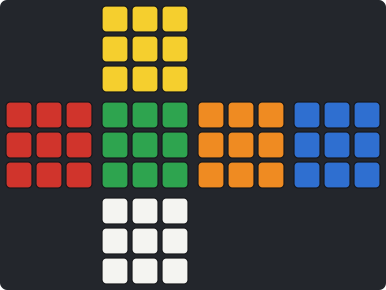
The whole site assumes the standard colour scheme, cube held white on the bottom, green in front:
| Face | Colour | Face | Colour | |
|---|---|---|---|---|
| Up (U) | 🟡 yellow | Down (D) | ⬜ white | |
| Front (F) | 🟩 green | Back (B) | 🟦 blue | |
| Right (R) | 🟧 orange | Left (L) | 🟥 red |
If your cube has other colours, nothing changes: just replace "white" with the colour you start on, and "yellow" with the one opposite it.
Why start with white on the bottom?
Many old tutorials build the white cross on top, then flip the cube over. That is a wasted step, and worse, it forces you to relearn your landmarks later. Here we build from the bottom up from beginning to end: that is what every fast method does.
A guarantee about the content
The diagrams on this site are not images taken from somewhere else: they are computed from the algorithms themselves by a cube simulator. A diagram therefore cannot disagree with the algorithm it illustrates.
Every algorithm has been checked by that simulator: that it does what it claims, and that it breaks nothing that was already solved. The lists of 57 OLL, 21 PLL and 41 F2L have been verified complete and free of duplicates.