F2L — the first two layers
This is the change that saves the most time, and it requires no algorithm to learn. Take as long as you need on this page.
The idea
In the beginner method you place a white corner, then, later, the edge that goes right next to it. So you visit the same spot twice.
F2L places both together. The white-green-orange corner and the green-orange edge form a pair: you join them in the top layer, then put the pair away in one motion.
Four pairs, four slots, and two thirds of the cube is done.
The gain, in numbers
Beginner method: about 8 moves per corner + 8 per edge, that is 64 moves for the two layers. F2L: about 7 moves per pair, that is 28 moves. For the same result.
The only move you need to understand
The whole of F2L rests on one observation: the trio R U R' pulls the pair out
of the slot, and R U' R' puts it back in.
Take a solved cube and do R U R'. Look at the front-right slot: the corner and
the edge have come out of it, together, into the top layer. Do R U' R' to put
them back.
That is all of F2L. The rest consists of bringing the pair into the right configuration before putting it away.
The method, in three questions
Faced with a pair, ask yourself these three questions in order.
1. Where is the corner?
- In the top layer → perfect, you can work.
- Stuck in a slot → pull it out with
R U R'(or its equivalent on the relevant side), then go back to question 1.
2. Where is the edge?
- In the top layer → perfect.
- Stuck in a slot → pull it out, same as for the corner.
3. How do I join them?
Both pieces are on top. You have to put them side by side, the right way round, then put the pair away. This is where all the intuitive work lies:
- Open the slot with
R U R'orF' U' F— that makes the room. - Bring the other piece above it with
U,U'orU2. - Close it up by undoing the opening move.
The reflex that unblocks 90% of cases
If you cannot see what to do: open the slot (R U R'), look at what
happens, U to reposition, close it up. In the vast majority of cases
the pair forms, or gets much closer to forming.
The three basic cases
These are the only ones you need to get going. All the others reduce to them in one or two moves.
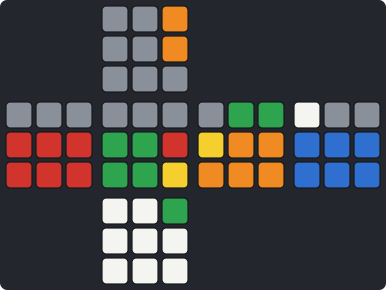
Direct insertion
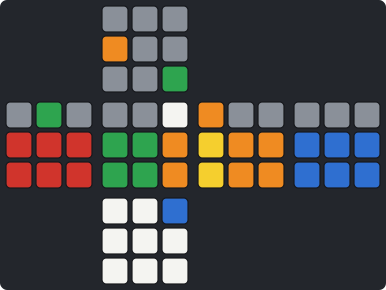
Open, align, close
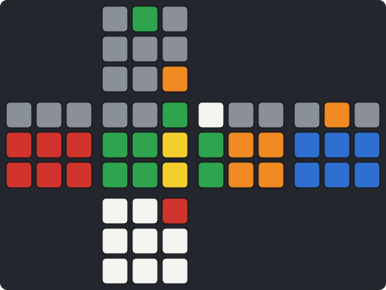
Undo then re-form
Four pieces of advice that change everything
Work all four slots, not just the right one
Many people rotate the cube so as to always work front-right. That is a
wasted rotation on every pair. Learn to insert front-left too, with
F' U' F and F' U F, which is its mirror.
Choose your pair, don't just take what comes
After the cross, look at all four pairs and start with the easiest — the one whose two pieces are already visible on top. While you insert it, you have time to spot the next one.
Slow down to go faster
An F2L executed at full speed but followed by three seconds hunting for the next pair is slower than a calm F2L where you search at the same time as you turn. That is lookahead, and it is the real subject.
Do not go and look at the 41 cases straight away
The full list exists, and it is useful — later. F2L learned by heart without being understood blocks you for a long time, because you will not know what to do with the cases you have not memorised.
Use it as a dictionary: when one particular case keeps costing you time, go and see how it is done properly.