2 · The white corners
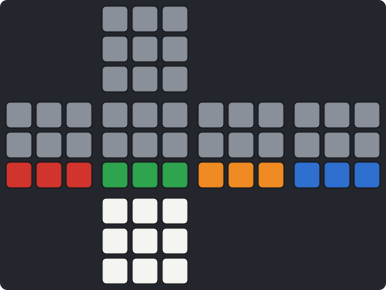
Four corners are left to place: the ones containing white. You are going to insert them one by one, always the same way.
The principle
A corner goes between three centres. The white-green-orange corner therefore goes at the intersection of the white, green and orange faces — there is no other possible spot.
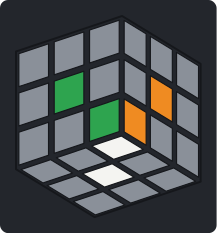
The manoeuvre
Every diagram in this section shows the state before you turn anything: look at them, identify your case, and only then execute.
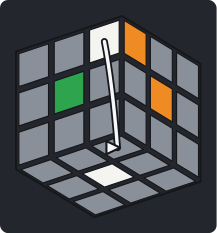
- Find a white corner in the top layer.
- Turn
Uto bring it directly above the hole it belongs in. The corner must be exactly above its place, one storey up. - Hold the cube so that this corner is top right, in front of you.
- Look at where its white sticker points. That, and only that, decides how many repetitions you need — always an odd number:
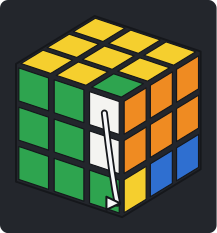
once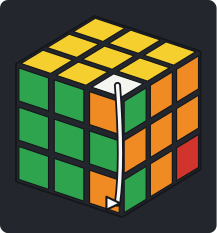
3 times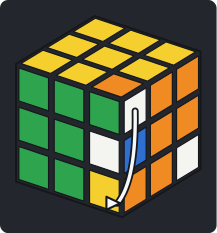
5 timesThe arrow shows the real path of the white sticker: it leaves the top layer and ends up underneath the cube, in its place.
Then run the sequence that many times:
R' D' R D
The corner drops into the slot, turns, comes back up, and eventually settles the right way round. Never stop part way through.
You don't have to count
Just repeat until the corner is seated, white underneath. The diagrams above are only there to reassure you when it feels long: five repetitions is normal, it is not a mistake.
What never works here is 2 or 4: an even number brings the corner back to exactly where it started.
Do not stop halfway
Between two repetitions the bottom of the cube looks broken. That is normal: the sequence pulls a piece out and puts it back. If you stop in the middle, you break the cross. Always go on until the corner is seated.
The corner is stuck at the bottom but wrong
This happens often: a white corner is already in the bottom layer, but in the wrong place or facing the wrong way.
Put it bottom right in front of you and do R' D' R D once. The corner goes
up into the top layer. You can now treat it normally.
Check
The white face is entirely white, and the four side faces have a bottom band of a single colour. One third of the cube is done.
Why this sequence works
R' D' R D is a commutator: it does one thing, does another, then undoes
the first move. The result is that it disturbs only one corner and puts it back
turned differently. You will meet exactly the same sequence again at
step 7 — it is the only algorithm used twice.